Few questions in Indian classical music education are as practically useful and as under-addressed as this one: should my child learn mridangam or tabla? Parents in Bangalore, a city where both Carnatic and Hindustani music traditions are actively practised and taught, face this decision regularly. Both instruments are deeply respected, both offer rich lifelong learning pathways, and both are in demand in their respective musical communities.
The choice is not simply a matter of personal preference. It is connected to which musical tradition the family is part of, what the child is likely to encounter in their musical education, and what community contexts — concerts, cultural events, school music programmes — the child will grow up in. This guide explains both instruments clearly and provides a framework for making an informed choice.
What Is the Mridangam?
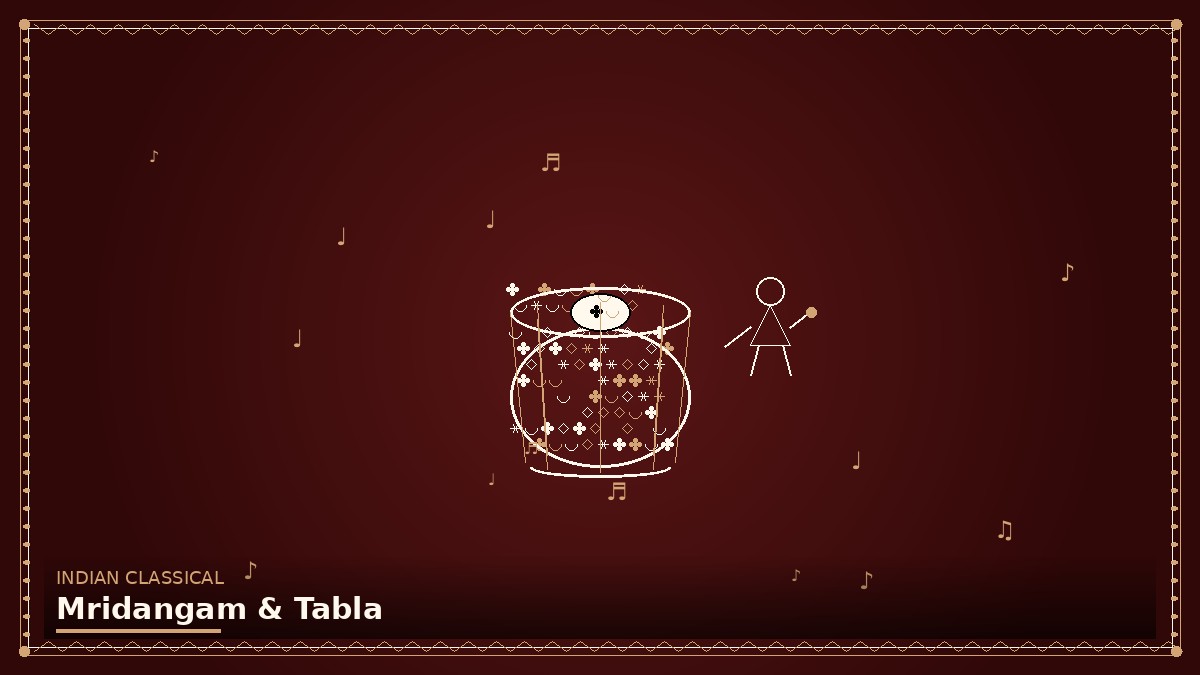
The mridangam is the primary percussion instrument of Carnatic classical music. It is a barrel-shaped, double-headed drum — played from both ends simultaneously. The right head (called the valanthalai) produces the higher-pitched tones, and the left head (called the thoppi or idam) produces the bass. The player sits cross-legged with the drum lying horizontally across the lap, playing both heads simultaneously with the hands and fingers.
The mridangam is an ancient instrument, mentioned in classical Tamil and Sanskrit texts and depicted in temple carvings and sculptures across South India. Its physical presence in South Indian classical music — accompanying vocal concerts, veena recitals, violin performances, and nadaswaram processions — is unmatched by any other percussion instrument in that tradition.
Playing technique: The mridangam uses an extraordinarily sophisticated system of finger and palm strikes on both ends of the drum simultaneously. The right hand produces a range of distinct tones through different combinations of finger strikes, slap patterns, and positions on the skin. The left hand adds bass tones and modulation through palm pressure. The sounds are codified in a spoken syllabic language called solkattu or konakkol, which students learn alongside the physical technique. Learning to produce even the basic tones cleanly takes considerable practice.
Tonal character: The mridangam has a bright, complex tonal signature. The right head, which is tuned to the tonic pitch (shadja) of the performance, has a dry, precise character suited to the rhythmically intricate structures of Carnatic music. The left head provides deep, warm bass that complements the right head's clarity. Together they produce the rhythmic foundation of Carnatic classical performance.
What Is Tabla?
Tabla is the primary percussion instrument of Hindustani classical music and one of the most widely recognised Indian instruments globally. Unlike the mridangam, tabla consists of two separate drums: the dayan (the smaller right-hand drum) and the bayan (the larger left-hand drum). They are placed on cushions in front of the seated player.
The dayan is tuned to the tonic pitch of the performance — it is a melodic drum in a way that few percussion instruments in any tradition match. The bayan produces bass tones that are modulated by pressing the heel of the left hand into the skin during playing, creating characteristic bends and resonances. The combination produces the complex, singing quality of tabla sound.
Playing technique: Tabla uses a different set of hand positions, finger strokes, and wrist movements from mridangam. Each distinct sound has a name — a bol — and the student learns to speak these bols before, alongside, and after learning to produce them physically on the drum. The combination of the dayan's tuned pitch and the bayan's bass creates a musical texture quite different from mridangam. Tabla accompanies khayal, thumri, ghazal, and dhrupad vocalists, as well as sitar, sarod, bansuri, and other Hindustani instruments.
Tonal character: Tabla has a more overtly melodic character than mridangam, partly because the dayan is tuned to a specific pitch that sings out clearly in a concert. The bayan's modulation adds a swooping bass quality that gives tabla its distinctive voice. Where mridangam projects rhythmic intricacy and power, tabla often has an almost conversational quality — particularly in the slower sections of Hindustani performance.
The Traditions They Belong To
This is the central distinction that most parents do not fully appreciate until they have been involved in classical music education for some time.
Mridangam belongs to the Carnatic tradition: South Indian classical music, with its own raga system, tala structures, compositional forms (varnam, kriti, pallavi), and concert formats. Mridangam is not used in Hindustani music. A child learning mridangam will be embedded in the Carnatic world.
Tabla belongs to the Hindustani tradition: North Indian classical music, with its own raga system, tala structures, compositional forms (dhrupad, khayal, thumri), and concert formats. Tabla is occasionally used in fusion contexts outside Hindustani music, and it is the most widely known Indian percussion instrument internationally, but its home is the Hindustani tradition.
For families in Bangalore who are already part of the Carnatic tradition — through community, family practice, or prior learning — mridangam is the natural choice. For families from North Indian backgrounds, or for those who are drawn specifically to Hindustani music, tabla is the clear answer.
For families with no particular attachment to either tradition, both are excellent choices. Bangalore offers good learning opportunities in both.
Comparing the Learning Journey
Getting started: Both instruments are accessible to young children, though teachers generally recommend waiting until a child is old enough to hold the posture and apply the required finger strength consistently. Tabla is sometimes considered slightly more accessible for very young beginners because each drum is smaller, and the techniques for the first several months do not demand quite the same simultaneous coordination as mridangam requires from the start. That said, both instruments become very demanding as the student advances, and early physical accessibility should not be the primary factor in the decision.
Notation and solfa: Carnatic mridangam is inseparable from the spoken syllabic language of konakkol/solkattu, which students learn in parallel with the physical instrument. This is one of the great features of Carnatic percussion education — the ability to speak complex rhythmic patterns with precision before, during, and after playing. Tabla has an equivalent system through bols. Both systems develop a musician's rhythmic intelligence profoundly.
Repertoire and community: Mridangam students in Bangalore will have access to a rich community of Carnatic music — school programmes, sabhas, arangetrams, competitions, and informal practice sessions. Tabla students participate in Hindustani music contexts, which are also well represented in Bangalore though somewhat less deeply woven into the city's formal music education infrastructure in purely numerical terms.
Examination pathways: Both traditions have examination boards and graded syllabi through various music academies and universities. Students who want formal certification in either tradition will find pathways available.
Physical Considerations
Mridangam size: The mridangam is a single large drum approximately 56-60 cm in length. It requires a certain hand span to play effectively, particularly for the techniques that involve the full palm of the left hand covering the left head. Most teachers find that children below age 6 or 7 are better served waiting until their hands are large enough, or starting on a smaller practice drum.
Tabla size: Because the tabla consists of two separate, smaller drums, they can be adjusted in placement to suit smaller players more easily. The dayan, played with the right hand, is approximately 14-16 cm in diameter. The bayan varies but is larger. Children with smaller hands can begin working on individual drum techniques before full coordination is required.
The Rhythm Connection: Why It Matters for Overall Music Education
One of the less discussed benefits of learning any classical Indian percussion instrument is what it does for a child's overall musical intelligence. The rhythmic systems of both Carnatic and Hindustani music are among the most sophisticated in the world. Students who grow up learning tala structures, internal subdivisions, and the practice of maintaining rhythmic awareness while improvising develop musical skills that serve them across any instrument or genre they encounter later in life.
Parents sometimes worry that percussion learning is limiting — that it is only useful if the child continues in classical music. The opposite is true. A student who has learned to understand and feel complex rhythmic cycles has a musical foundation that is broadly applicable.
Final Thoughts
If your family is rooted in the Carnatic tradition, learn mridangam. If you are drawn to Hindustani music or come from a North Indian background, learn tabla. If you have no strong prior musical background, consider which community, teachers, and performance opportunities are most accessible to you in your part of Bangalore — and let that guide the choice.
Both instruments are great. Both traditions are profound. The decision between them does not need to be agonised over — pick the one that connects to your musical life and commit to it.
New Veena Musicals in Jayanagar stocks both mridangam and tabla. Visit us to inspect the instruments, ask our team about quality differences across price levels, or WhatsApp us for current availability and pricing.